
Please wait, I'm coming over...



 |
|
|
Last Changed 11/2/2016 |
||
|
We knew we wanted to outfit Red Rover with an "air-ride" hitch! There is an interesting effect when using a Medium/Heavy Duty Truck (MDT/HDT, Class 6-8), instead of an under-rated 1-ton dually pickup truck, to pull a heavy trailer. With the pickup truck, the trailer mass is greater than the truck, and road bump impact is transferred to the truck. With the MDT/HDT, the truck mass is about equal to the trailer, and the trailer gooseneck absorbs the impact. Anecdotal evidence shows that the trailer can sustain frame damage from this impact. By using an “air ride” hitch, air bags are placed in between the fifth-wheel hitch plate and the truck frame. This reduces the inertial impact between the trailer and the truck. Bill Farlow was a leader in the discussion of the needs for “air ride” hitches. You can scan the internet for articles written by Bill. Another consideration for what fifth-wheel hitch dealt with the frame height of Red Rover. The top of the frame rails are about 40” high. A normal semi-trailer hitch plate is about 5” to 7” high. This yields a hitch plate height of 46”. This is what we measured on several fifth-wheel trailers. Finally, the traditional hitch used by semi-tractor is really not suited for fifth-wheel towing. By nature, commercial trucks are on flat pavement. While not rough terrain, campgrounds are not always flat. The connection between the truck and the fifth-wheel needs some lateral (side-to-side) motion. Having some damping on this lateral action is also important for towing stability. Unhampered, the lateral motion could allowed the trailer to wallow behind the truck. A current trend is to use a air cushioned trailer pin with a traditional hitch. This does provide up-down cushioning but does not handle the twisting action between the truck and trailer. All the above issues brought us to a Air Safe Hitch. |
||
 |
It is important to have the fifth-wheel plate of the truck and the fifth-wheel pin of the trailer at a height where the trailer rides as close to level as possible. If the front of the trailer is held high, this puts more load on the rear axles of the trailer and reduces the load on the front axles. If the imbalance is enough, the rear axle could actually be over-loaded. This is not good for axle wear and trailer stability. | |
click on images to enlarge |
||
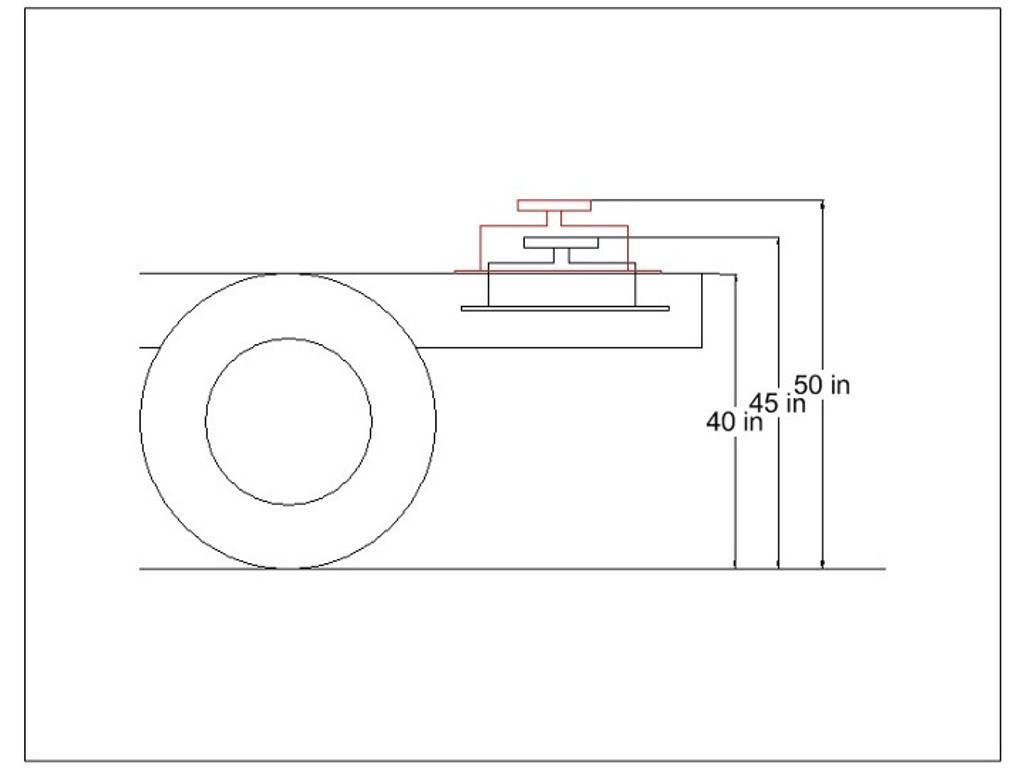 |
A normal semi-trailer hitch only has to pivot fore and aft. Therefore, the difference between the surface of the hitch plate and the frame is minimal. With an "air ride" hitch, there must be room for air bags between the hitch plate and the frame. Most of the “air ride” hitches have minimum heights of 15”. This is fine for pickup truck installations where the bed is much lower than the frame of a MDT/HDT. There are a few "air ride" hitches that have minimum heights of 10”. This is better, but added to the 40” of the Volvo frame, it would be 50” high, far too high for the trailer pin. | |
click on images to enlarge |
||
Raising the trailer could be an option. But most of the trailers we were looking at were pretty tall already. So, we decided to inset the hitch between the frame rails. We have to give credit to Bob Speckman, who did this with his Volvo. Pictures of his installation are at Bob Speckman's TrailerSaver Installation. The distance between the Volvo rails was 26”. This limited the choices of “air ride” hitches to two, the TrailerSaver and the Air Ride Hitch. The decision to inset the hitch between the frame rails brought another consideration into the process. The ideal location for the hitch places the hitch pin over the center of the axle. With a hitch mounted above the rails, this is very easy. Insetting the hitch means we had to deal with items located between the rails. The main consideration was a crossmember that is between the rear hangers of the axle. In Bob Speckman's installation, he chose to cut the crossmember across its vertical height. We wanted to retain the crossmember intact. We therefore had to move the hitch back to clear the crossmember. Having the hitch pivot behind the center of the axle has two effects. When backing the trailer, directional control of the trailer will be more sensitive but it still will be far easier than backing a travel trailer. A benefit of having the pivot point farther back is that the trailer will track closer to the track of the truck. |
||
 |
The other thing we had to be aware of was not to have the frame extend too far behind the wheels. The issue here is if we put boxes behind the wheels like we plan to do, if the length gets too long, there is a chance of the boxes bottoming on a steep incline. The decision was made to place the hitch as close to the crossmember and behind it. We estimate that we can still clear a 11º ramp. | |
click on images to enlarge |
||
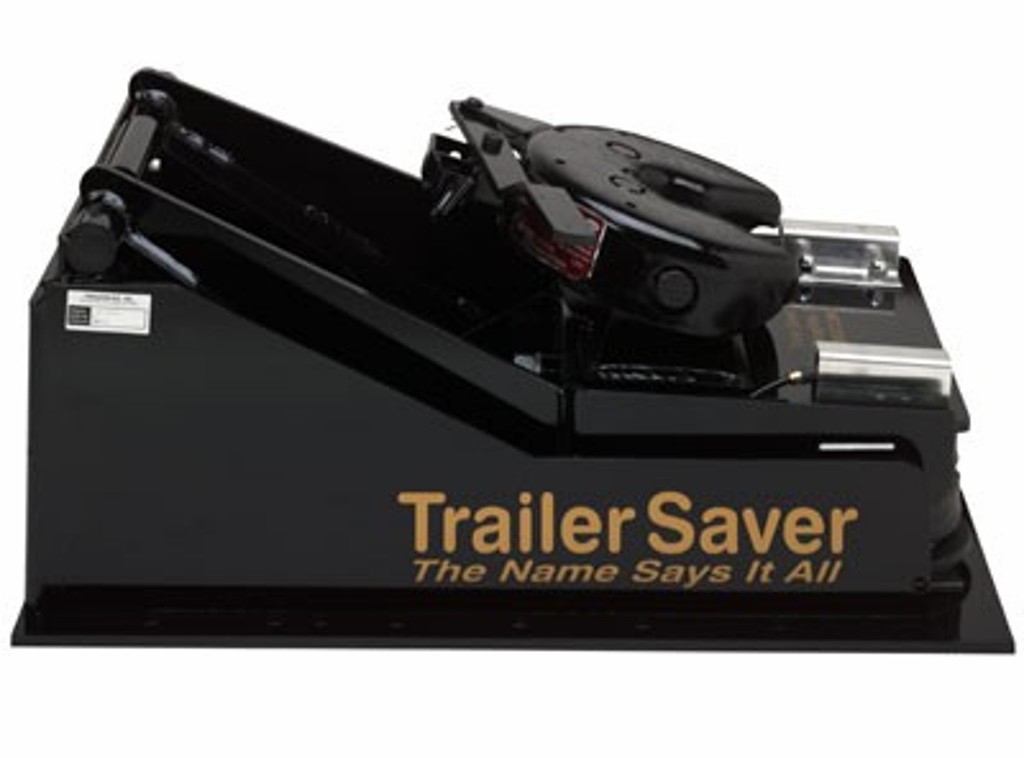 |
The TrailerSaver hitch uses a plate pivoted at the forward end and the air bags at the back. This gives up-down cushioned motion. This hitch had a very good track record. It would have done the job. Get more information on the TrailerSaver at TrailerSaver.com. | |
click on images to enlarge |
||
Update |
||
 |
The ET Hitch came onto the market since we bought our hitch. This is a very robust hitch designed for HDT trucks, mounting directly to the frame rails. The major difference from the TrailerSaver is the use of parallel link arms to provide a pure vertical movement of the hitch head on the air bags. The design also prevents over-run if the trailer should ever be pushed into the truck. Get more information on the ET Hitch at ETHitch.com. | |
click on images to enlarge |
||
Update |
||
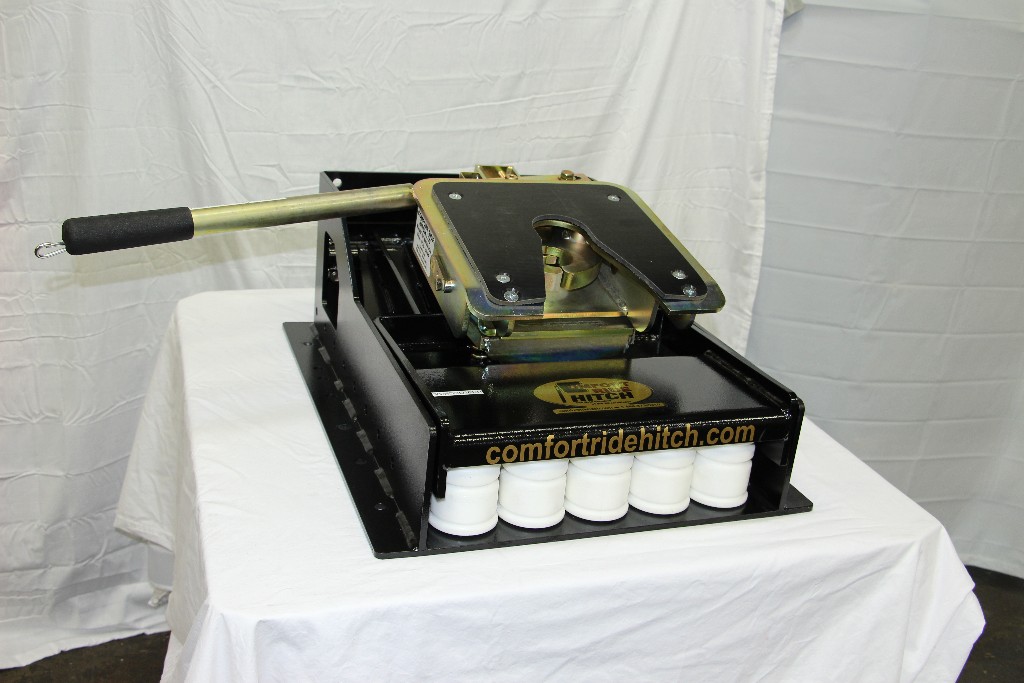 |
The Comfort Ride Hitch came onto the market since we bought our hitch. This is a very robust hitch evolved from the TrailerSaver hitch using new technology air cells to replace air bags. The air cells dissipate vertical energy and are not subject to aging like air bag. Get more information on the Comfort Ride Hitch at Comfort Ride Hitch. | |
click on images to enlarge |
||
Update |
||
 |
The original Advanced Air Hitch has been bought out by Air Hitch Technology and it purchased through
Air Safe Hitch. The Air Ride Hitch (ARH) has two models, the 25K and the 32K. We choose the 32K to have extra margin in towing capacity since we will probably be at the upper reaches of fifth-wheel weight. |
|
 |
The ARH 32KS has a plate with an air bag at two rear corners with a swivel hinge point at the front. The swivel hinge is a large tie
rod end like ball joint. This allows vertical as well as right-left twisting. This provides for cushioned and dampened lateral movement
as well as the up-down. Get more information on the Air Ride Hitch at
Air Safe Hitch.com Many hitches have a pivoting head but have no damping action on the lateral movement. |
|
click on images to enlarge |
||
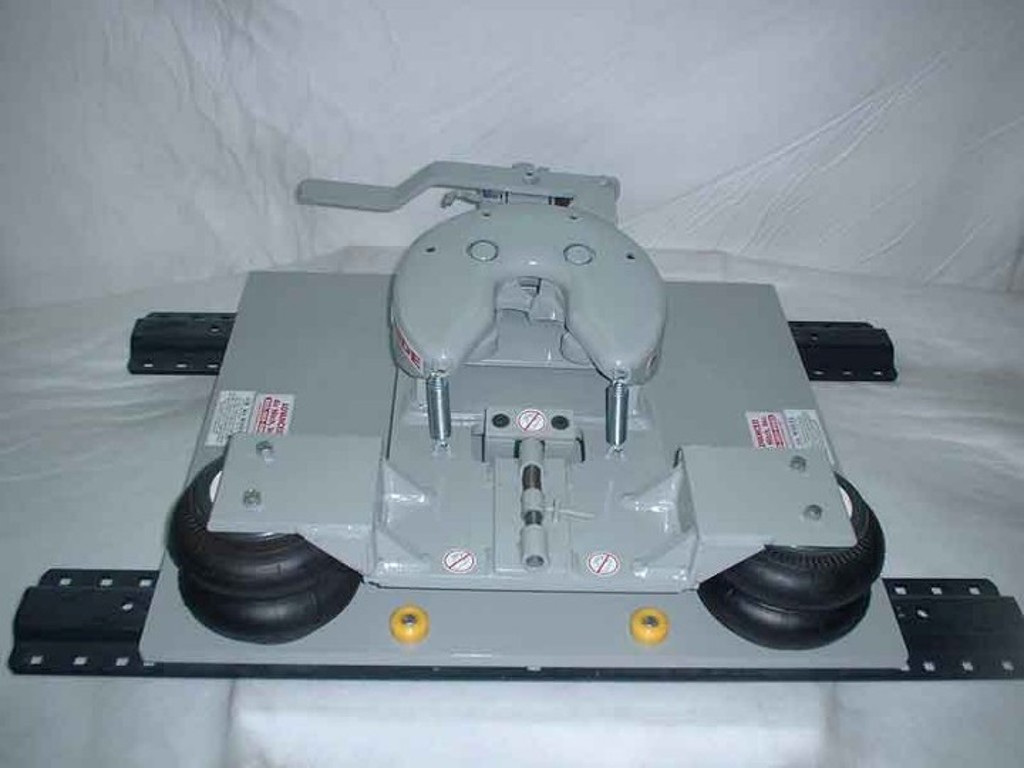 |
We felt that since everything we own would be riding on this hitch, the Air Ride Hitch would be the better choice. The Air Ride Hitch costs a little more than the TrailerSaver, but as a value proposition we felt the 4-way motion over 2-way was worth it. | |
 |
||
 |
||
click on images to enlarge |
||
Disclaimer: The information in this site is a collection of data we derived from the vendors and from our personal experiences. This information is meant as a learning guide for you to make your own decisions Best practices and code should always be followed. The recommendations we make are from our personal experiences and we do not receive any compensation for those recommendations. |